Tuesday, March 28, 2006

New Approaches to Economic Development

We need to cultivate practices that create open conversations leading to new levels of collaborative behavior. The last two days I participated in an economic development program at Baldwin-Wallace College in Berea, Ohio. The conference was put on by the Institute for Open Economic Networks (I-Open). The conference was principally held to delve into new approaches in regional innovation.

What was so exciting was the breadth of experiences, positions, backgrounds of the twenty-four who elected to participate. There were people from Cleveland; Jefferson City, Missouri; Wayne County; all over Cuyahoga County; Nashville, Tennessee; and Indianapolis, Indiana. There were people who work for the City of Cleveland, TVA, Cuyahoga County, various non-profit organizations, the Cleveland Institute of Art, Case Western Reserve University, Myers University, the Cuyahoga County Library.

There were people who are economic development directors, librarians, students, unemployed, non-profit administrators, small farm supporters, network builders, community development leaders, car restorers, technology directors, bio-fuels engineers, agricultural innovators. There were people in suits, people in jeans, and people in skirts.

We got involved in the discussion of first curve versus second curve innovation strategies, quality connected places, building connected networks, building innovation networks, growing regional economies, appreciative networks, authentic engagement, network weaving, collaborative projects.
All of these people came to the table and participated in open conversations building trust, finding common ground, and building new collaborative networks. We developed new ways to help focus our actions leading to bring innovation to our communities.

Overall, we looked at ways and committed ourselves to teach and encourage new behaviors in regional innovation and economic growth. There will be another conference in June at Baldwin-Wallace and I hope that more will be there because the depth of the experience depends upon the participation, stories, and comments of those at the table.

Wednesday, March 22, 2006

Needing New Behaviors

I fully agree with Guhan Venkatu who is an economic analyst at the Federal Reserve Bank of Cleveland, that the reasons for Cleveland’s woes are not what are commonly cited. Guhan Venkatu presented an economic commentary for the Federal Reserve Bank of Cleveland titled “Cleveland (on the) Rocks,” February 2006; posted March 2006 which may be read here. However, the reasons put forward by Venkatu fail to take into account what I feel may be the most major factor in Cleveland’s failure to thrive. Cited, but taking a minor position, are lack of qualified workers, the quality of life, access to transportation or distribution networks, or regional regulation and tax policies. Many of those problems may also be more perceived than actual.

Cleveland has long had a problem with the behavior of its leaders in relationship to each other and to new entrepreneurs. The region needs to build an aura of trust and collaboration. The collaboration needs to be that which encourages individual identity without the fear engendered by the thought of consolidation.

Cleveland leaders need to encourage all levels of entrepreneurship from concept, startup, mid-market, and maturity. Open communication also needs to take place. We need to have strategic thinking that leads to strategic doing rather than strategic planning. Time and again over the last several decades consultants have come in issuing strategic plans over eighteen month periods, saying the same thing. The region holds feel good events with little or no focus on how and where we move forward. We finance the flash that brings stars to the eyes but which soon fades. We look for the short term gain, especially for real estate developers and the construction industry which fail to provide for sustainable economic development.

We all need to work with our schools, colleges, universities, and libraries to teach new models of behavior, treating each other in ways that build mutual respect and trust. We need to re-envision our agendas into categories that are less narrowing: envision brainpower versus education, collaborative networks versus hierarchies, wealth creation versus command and control.

Sunday, February 19, 2006

Social Network Analysis


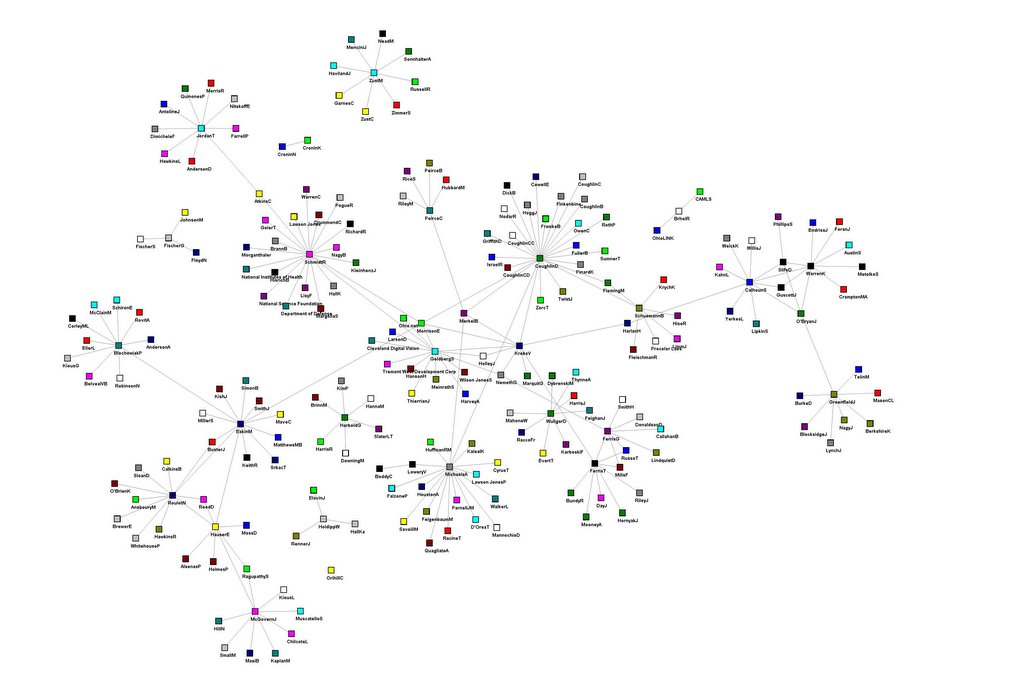
The picture here is that of a network map utilizing the software of Valdis Krebs. (see OrgNet.com) Valdis is someone with whom I collaborate in my work in Northeast Ohio. The software helps visualize collaboration within a cluster of individuals and organizations and creates a method of analyzing changes and growth in relationships.

We are using the software to show the impact of work in regional economic development utilizing open source economic development methods developed and implemented by Ed Morrison, Betsey Merkel, Susan Altshuler, myself and I-Open partners.
(see I-Open) The nodes at the center of clusters represent people who have attended civic forums regarding developing a innovation network in Midtown Cleveland. Those attending have been asked to submit the names of those with whom they have shared ideas, mentored, or received advice.

There are some people who have attended who are also on the submitted lists and there are some people who are on several submitters' lists.

Monday, February 06, 2006

People Make the Space

I work in a large room with two doors and no windows. One door opens onto a hallway with the opposite wall all windows so that by opening our door I see outside and can determine whether it is day or night. There are three large support columns in the office which is about fifty feet by thirty feet. We have three desks and three tables, a mixture of chairs, old office furniture stored by a business down the hall, and until recently a collection of mis-matched office partitions leaning against one wall. All of the items of furniture are well used loaners from the building and the staff.

The room is painted white with much fluorescent lighting. It used to be the library for the Regional Sewer District. One might think that such a space would be very confining, but I have not yet mentioned what is also in this space. This space is filled with innovative minds that are dedicated to building the economy in the region. These are people who are open and honest and live by building trusting relationships with and between others. There are multiple initiatives posted on the wall on constantly changing working papers.

Every day that I am there, there are people sticking their heads in to say hello, comment on what they or their organizations are thinking and doing. They want to discuss their ideas, our ideas, or someone else's ideas. Often they grab a cup of coffee and a cookie or bagel. Our office and forums seem to run on cookies and coffee.

There are days there is so much interesting conversation andstrategicc doing that it is hard for me to get done those tasks which I had planned for myself. All of the activity makes the day challenging as well as fun and rewarding.

And, as often is the case, it is the people that make the space. Come be part of it.

Monday, January 16, 2006

Open Source Networking

We all utilize in our verbal communications words and phrases that have multiple meanings, are unclear, or have been hijacked to have specific but inappropriate meanings. These words are often referred to as “code words”. In our communications we need to be careful not to abuse language in creating code words or to use phrases that will be misinterpreted.

One such word that has come into such a code realm is networking. When we use the word networking, do we mean building a collaborative network? Do we mean introducing person A to person B? Do we mean suggesting that person A contact person B? Do we mean building our own social network?

As so many have abused the concept, for many networking has become a negative practice. What does networking really mean? If it can be used both to describe using contacts to achieve a personal ends as well as to describe collaborative behavior, then we need to make clear each time we use the word what it means. Either that or not use the word but use a word or phrase which will more appropriately describe what is intended.

What we say may clearly mean one thing to a certain group of people but something else entirely to another. Such a phrase is Open Source. Those in the information technology field understand it fairly well, economic development professionals in another way, and the general public not at all. The general public may try to interpret it looking at the words open and source but what comes out is not what is meant.

The International Association for the Advancement of Creative Maladjustment

On this day of celebration of Martin Luther King, I quote from the sermon given by The Reverend Martin Luther King at St. Paul's Episcopal Church in Cleveland Heights on May 14, 1963 from the pulpit to an overflowing church. In it he asks all of us to be maladjusted in terms of not accepting the bigotry of religion and society. The same applies to the acceptance of the old way of behaving in the economic arena: needing approval from the powerful, accepting short term gains as the ends, dealing with each other in uncollaborative and unethical ways.


There are many technical words in every academic discipline which become stereotyped and cliché. I want to mention one of these words. It is the word maladjustment. It is a great technical word in modern psychology, which has become a ringing cry. It is the product, or the modern child, of psychology.

We all want to live the well-adjusted life in order to avoid neurotic personalities, but I must be honest with you by saying that there are some things within our social order to which I am proud to be maladjusted, and to which I call all men of good will to be maladjusted until the good society is realized.I must confess that I will never adjust myself to segregation and discrimination. I will never become adjusted to religious bigotry. I will never adjust myself to economic conditions that will take necessities from the many and give luxuries to the few. I will never become adjusted to the madness of militarism: the self-defeating effects of physical violence. In a day when Sputniks and Explorers are dashing through outer space, guided ballistic missiles are carving highways of death throughout the stratosphere, no nation can win a war. There is no longer a choice between violence and non-violence. It is either non-violence or non-existence. The alternative to disarmament, the alternative to suspension of nuclear tests, the alternative to strengthening the United Nations and working toward disarming the whole world, may well be a civilization plunged into the abyss of annihilation. I never intend to adjust to the madness of militarism.

It may well be the greatest need of the hour, the greatest need of our world, to have more maladjustment. This is why I am calling for the immediate formation of a new organization, “The International Association for the Advancement of Creative Maladjustment.” There is a need for men and women to be as maladjusted as the prophet Amos. In his day, in the midst of injustices, his proud words echo across the centuries, “Let justice roll down like waters, and righteousness like a mighty stream.” There is a need for men and women today to be as maladjusted as Abraham Lincoln, who had the vision to see that this nation could not exist half-slave and half-free. There is a need for us to be as maladjusted as Jefferson, who in the midst of an age amazingly adjusted to slavery cried with words rising to cosmic proportions, “All men are created equal.” There is a need for men to be as maladjusted as Jesus of Nazareth, who could stand amid the men and women of his day, amid the intricacies of the formidable military machinery of the Roman Empire, to say, “He who lives by the sword will perish by the sword,” and cry out, “Love your enemies; bless them that curse you, pray for them that despitefully use you.”

Through such maladjustment, we will be able to emerge from the darkened midnight of man’s inhumanity to man into the bright and glittering daybreak of freedom and justice.

With this faith, we will be able to go on to carve a tower of hope on the mountain of despair and bring into being that great dream and create right here in America a nation where all men will live together in brotherhood and where every man will respect the dignity and worth of the human personality.

Read the whole sermon here.

Saturday, December 31, 2005

Flying Away

The first week of the New Year a friend of mine flies off from Cleveland to Phoenix in search of a satisfying and appropriate position of employment which he was unable to find in Cleveland. We had a going away party for him at Grovewood Tavern on Friday and I sure am disappointed that he had lost a vision of hope in Cleveland; but, when one has been looking for two years, you have to “do what you gotta do.” I am not disappointed in his decision, but in the situation that led to his leaving and I wish him well.

A mutual friend of ours is currently a community/civic leader there and is starting him off with a number of contacts in his network. The report is that Phoenix does not have the supportive communities that Cleveland does which is probably because Phoenix is one of the fastest growing regions in the country.

I am firmly embedded in Cleveland although I have been in his situation. As a sixth or seventh generation Clevelander my social networks continue to grow and my communities are tremendously supportive. I thoroughly enjoy what I am doing and the people I work with in all my endeavors.